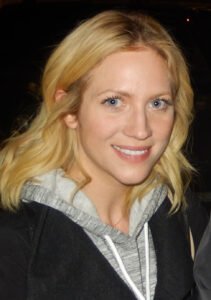
Amanda Seyfried Reacts to Oscar Buzz for Her Elizabeth Holmes Turn in You Can See Everything

Photo: CaseyJNewell via Wikimedia Commons (CC BY-SA 4.0)
Amanda Seyfried has heard the Oscar chatter, and her response was about as low-key as it gets: one word, in all caps, plus a pair of heart-eyes emojis. No long statement. No humble-brag paragraph. Just “TIMOTHY.”
That was her reply in the comments of a clip from The Kyle Buchanan Show, where actor Timothy Simons had just spent several minutes singing her praises for her work in You Can See Everything. It’s the kind of exchange that tells you a lot about where Seyfried is in her career right now — respected, unbothered, and suddenly back in the middle of an awards-season conversation she didn’t exactly go looking for.
The 40-year-old actress appears in the film as herself, but she also steps into the shoes of Elizabeth Holmes in reenacted scenes. If that name rings a bell, it should. Seyfried already played the disgraced Theranos founder once before, in the Hulu limited series The Dropout, and she was so convincing that she walked away with an Emmy for it. Returning to Holmes, even in a very different kind of project, was always going to get people talking. What nobody quite expected was how quickly the talk would turn to the Oscars.
What Timothy Simons actually said
Simons, best known to a lot of viewers right now from Nobody Wants This, appeared on Buchanan’s show and talked openly about what he’d seen on screen. He admitted straight away that he wasn’t sure how the Academy’s rules treat a film like this one, which mixes documentary material with staged recreations. “I would understand if somebody was like, ‘Well, this is a documentary. It’s not eligible.’ I don’t know how the rules of this work,” he said.
Then he got specific, and that’s when his praise stopped sounding like polite awards-season chat and started sounding like something he genuinely couldn’t shake. He described watching the film twice, and both times being stopped cold by the same moment: a recreated scene in which Nathan Fielder visits Holmes in jail. Seyfried, he said, does a small, almost shy hug — he called it a “tippy toe hug” — and the camera catches her face over Fielder’s shoulder.
“Both times that I saw it, my mind had completely melded the two people together,” Simons said, explaining that in that shot he wasn’t really seeing an actress playing Holmes anymore. He was seeing Holmes herself, in a way he struggled to put into words. He went on to say the film cuts from the real Fielder outside, walking into the jail, to a built set inside, and that the shift is exactly how movies work — a performance, in a constructed space, doing real emotional work.
His verdict was plain: “I don’t know how the rules break out but just what I saw, the performance was incredible.”
Buchanan, for his part, stepped in with a bit of good news for anyone already filling in a predictions ballot. From what he understands, Seyfried would be allowed to be nominated. That single clarification matters a lot, because the eligibility question is usually the first thing that kills buzz for a hybrid film like this one. If the door is open, the conversation can actually go somewhere.
Why A24 is backing her for Supporting Actress
According to reports, A24, which produced the film, is set to launch a Best Supporting Actress campaign for Seyfried. That placement makes sense when you think about how the film is built. She isn’t carrying the whole thing on her shoulders in the traditional leading-role sense. She appears as herself, then slips into Holmes for the recreations, and the power of what she does comes from how little she seems to be forcing it.
Awards campaigns love a clear story, and this one has a pretty good one. An actress revisits a role she already mastered, finds something new in it the second time around, and does it inside a project that doesn’t fit neatly into one box. Voters tend to remember performances that surprise them, and a lot of people who thought they’d already seen everything Seyfried could do with Holmes are now saying, well, apparently not.
There’s also the timing. Awards season loves momentum, and momentum loves a clip that travels. The Buchanan show clip did exactly that, landing on Instagram, picking up Seyfried’s own delighted reaction, and then getting passed around by film fans who love nothing more than a “wait, she could actually get nominated for this?” moment in November. November is early, but early buzz is how a campaign gets its footing before the bigger precursor awards start handing out nominations.
She’s played Holmes before — and won for it
It’s worth remembering just how high the bar already was. When Seyfried took on Holmes for The Dropout, she wasn’t just doing an impression. She studied the voice, that famously low register, the wide-eyed stare, the black turtlenecks, and the strange mix of confidence and evasiveness that made Holmes such a hard person to pin down. She also had to make a woman accused of massive fraud feel human without ever letting the audience forget what she did.
She pulled it off. The series became one of the most talked-about true-crime dramas of its year, and Seyfried won the Emmy for Outstanding Lead Actress in a Limited Series. That win changed how a lot of people talked about her. She’d been a star since her teens, but The Dropout gave her a different kind of credibility — the kind that makes directors, writers, and yes, awards voters, take a second look.
Coming back to Holmes in You Can See Everything could easily have felt like a retread. Instead, judging by Simons’ reaction, it feels like a coda. The jail-visit scene he kept returning to isn’t a big courtroom speech or a boardroom showdown. It’s a hug. A small, awkward, human gesture, caught in a single shot. Sometimes that’s the stuff that sticks with people long after the louder scenes fade.
A career built on left turns
Part of what makes this moment fun is how little it looks like a typical career plan. Seyfried broke out as Karen Smith in Mean Girls back in 2004, all ditzy one-liners and pink on Wednesdays, and she could have spent years playing variations on that girl. She didn’t. She went on to sing her way through Mamma Mia! as Sophie, a role she’d return to a decade later, and she held her own as Cosette in the big-screen Les Misérables in 2012.
Then came the pivot that a lot of actors talk about and very few actually make: smaller, stranger, more grown-up work. She played Marion Davies in David Fincher’s Mank in 2020, all old-Hollywood glamour with a sharp edge underneath, and earned her first Oscar nomination, for Best Supporting Actress. She’s done horror, comedy, musicals, prestige television, and voice work, and she’s done it without ever seeming desperate to prove she can do all of it. She just does it, and moves on to the next odd, interesting thing.
That restlessness is probably why a project like You Can See Everything suits her. It’s not a straightforward biopic, and it’s not a straight documentary either. It lives in that in-between space where an actor has to trust the audience to follow along, and Seyfried has spent twenty years building exactly that kind of trust. People will go with her, even when the premise sounds a little hard to explain at a dinner party.
She’s also stayed busy in ways that don’t always make the loudest headlines. Her recent turn in The Testament of Ann Lee, in which she plays the founder of the Shakers, has had film-festival audiences talking, and it’s another example of her appetite for roles that ask a lot of her — singing, intensity, conviction, and a fair amount of nerve. Put that next to a return to Holmes, and you get a picture of an actress who is, frankly, in a really interesting phase.
What happens next in the race
So, what actually happens from here? If A24 runs the Supporting Actress campaign as reported, expect Seyfried’s name to start popping up on prediction lists, in critics’ group chatter, and in those early “surprise contenders to watch” roundups that show up every December. None of that guarantees a nomination, of course. The Supporting Actress field is crowded every single year, and hybrid films still make some voters nervous.
But the ingredients are there. A respected studio behind her. A specific, memorable scene that people keep describing to each other. A co-star who can’t stop talking about how good she is. And Seyfried herself, reacting with a single joyful word instead of a polished campaign statement, which might be the most on-brand thing she could have done.
It’s also a reminder that awards buzz doesn’t always start with a trailer drop or a festival standing ovation. Sometimes it starts with one actor, on a podcast, trying to explain why a hug in a fake jail cell messed with his head — and the actress in question popping into the comments to say, basically, thank you, I see you, I love this.
Whether Seyfried ends up with a second Oscar nomination remains to be seen, and she’d probably be the first to laugh off any attempt to call it now. For the moment, though, she’s got something a lot of campaigns would pay good money for: people talking about a performance, in specific terms, because they actually felt something watching it. That’s not a bad place to be in November. Not bad at all.
Source: Just Jared