Robbie Williams Has the Classiest Response to Olivia Rodrigo ‘Copying’ His Song — and a Message Just for Her
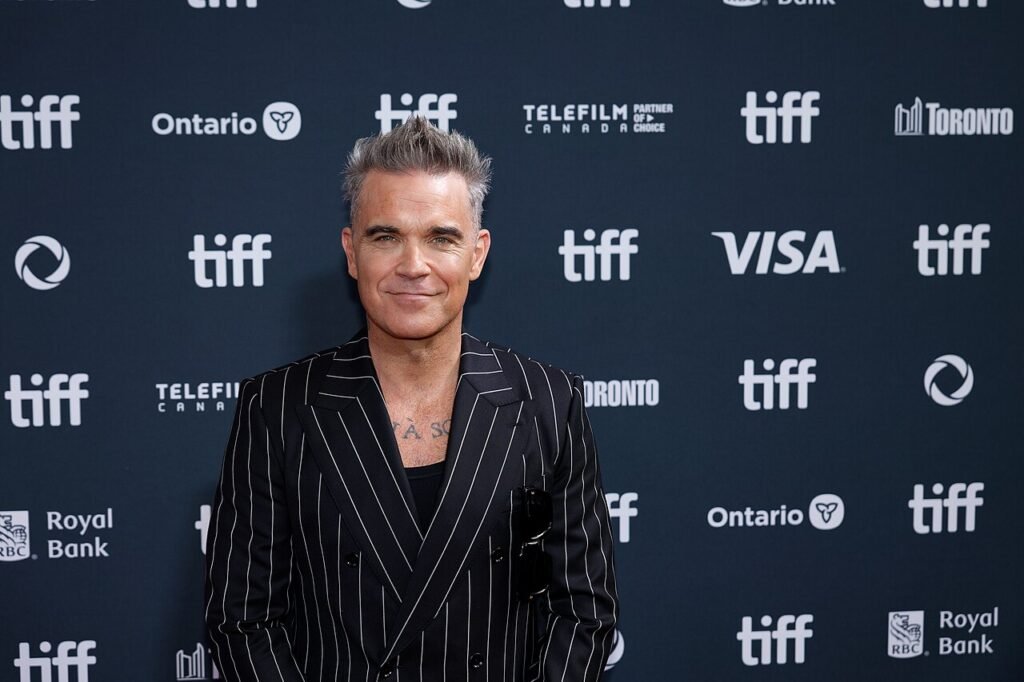
Photo: Kevin Payravi via Wikimedia Commons (CC BY-SA 4.0)
Robbie Williams could have gone the other way. He could have lawyered up, fired off a stern statement, or let the internet do what the internet always does — turn a passing resemblance between two songs into a full-blown feud. Instead, he did something far rarer in pop music in 2026: he laughed it off, defended the other artist, and told her she was brilliant.
The whole thing started with a Christmas song. Olivia Rodrigo, 23, dropped a new holiday track called “Take Me Home (4 Christmas),” and within days, listeners started pointing out that parts of it sounded an awful lot like Robbie’s 2012 hit “Candy.” Others heard echoes of The Waitresses’ 1981 classic “Christmas Wrapping” too. It was the kind of comparison that usually ends with lawyers and subtweets. Robbie had other ideas.
Posting on Instagram, the 52-year-old singer made it clear from the first line that he wasn’t looking for a fight. “I love Olivia Rodrigo,” he wrote. “It sounds to me as though she may have accidentally stumbled across a musical echo of mine in one of her new songs. And do you know what? I couldn’t care less.”
That’s not the kind of sentence you expect from a pop star whose song is supposedly being copied. But Robbie wasn’t done. He went on to say he didn’t know — and didn’t want to know — whether there was any kind of publishing or copyright issue at play. “I’m not going after her,” he wrote. “Because I think at some point, some ****ing sanity has to prevail.”
And honestly? He’s got a point. A big one.
There Are Only So Many Notes
Robbie’s argument was simple, and it’s one that musicians have been making for years, usually to deaf ears. There are only so many chords and notes in Western music. Twelve notes. A handful of chord progressions that show up in thousands of songs. Sooner or later, somebody is going to land on a melody that sounds like something you’ve heard before — without ever having meant to.
“Genuine theft is genuine theft. Artists deserve to be protected,” Robbie wrote. “But there’s a difference between protecting your work and treating every vaguely familiar sequence of notes as a winning lottery ticket.”
That’s a sharp line, and it cuts right to the heart of how messy music copyright has become. Over the past decade, the industry has seen a string of high-profile cases where artists were dragged into court over songs that shared a vibe, a groove, or a few notes in common. Ed Sheeran has been sued more than once — and won — over claims his songs copied other people’s work. The “Blurred Lines” case, which found Robin Thicke and Pharrell Williams liable for copying Marvin Gaye’s “Got to Give It Up,” sent shockwaves through the industry precisely because the two songs didn’t share a melody so much as a feel. Ever since, songwriters have been a little more nervous, a little more cautious, and a little more likely to hand out writing credits just to be safe.
Robbie clearly thinks that caution has gone too far. “We all stand on the shoulders of people who came before us. Sometimes consciously. Sometimes without even knowing it,” he wrote. “If we keep punishing people for accidentally arriving somewhere somebody else has already been, eventually we’re going to frighten the creativity out of everyone.”
It’s hard to argue with that. Pop music is built on borrowing — on chord progressions, drum patterns, and melodies that get passed down, tweaked, and reimagined by every new generation. The Beatles borrowed from Chuck Berry. Madonna borrowed from ABBA. Olivia Rodrigo herself has been open about her influences, from Taylor Swift to Paramore to Alanis Morissette. The line between inspiration and imitation has always been blurry, and Robbie’s point is that the industry needs to leave some room for accidents.
From “Candy” to Christmas
For anyone who needs a refresher, “Candy” was one of the biggest songs of Robbie’s solo career. Released in 2012 as the lead single from his album Take the Crown, it shot straight to number one in the UK and stayed there for two weeks. Co-written with his old Take That bandmate Gary Barlow, the song was a swaggering, brass-heavy pop track that became a staple of Robbie’s live shows. It’s the kind of song that gets stuck in your head after one listen — which, in a way, is the whole problem. The catchier a song is, the easier it is for a few notes of it to show up somewhere else entirely by coincidence.
Olivia’s “Take Me Home (4 Christmas),” meanwhile, arrived as part of her holiday-season output — a festive, guitar-driven track that leans into the cozy, nostalgic sound of a Christmas classic. It’s not a single trying to top the charts in the usual sense; it’s a seasonal gift to fans, the kind of song that gets dusted off every December. The fact that listeners picked up on similarities to both “Candy” and “Christmas Wrapping” says something about how deeply those melodies are lodged in the collective memory. These are songs people have heard a thousand times, in shops, in cars, at parties. Of course a new melody is going to brush up against them.
And that’s exactly what Robbie seems to be saying: this isn’t theft, it’s the natural result of writing pop songs in a world where every great hook has already been hummed a million times.
A Message Just for Olivia
Robbie saved the best part for last. Addressing Olivia directly, he wrote: “Olivia, if you’re reading this, I think you’re ****ing brilliant.”
Then, in a joke that only Robbie Williams could land, he asked her to stop swearing so much on stage. “It makes me feel like I have to keep up,” he wrote. “And frankly, I’m already swearing far more than is necessary. Lots of love and Happy Christmas.”
It’s a funny, warm, generous sign-off — and it tells you a lot about where Robbie is in his career right now. This is a man who has been famous for more than three decades, who survived the boy-band machine, a very public solo career, addiction, comebacks, and reinventions. He doesn’t need to pick a fight with a 23-year-old over a Christmas song. He’s been the young artist under the microscope. He knows what it feels like to have every note you write compared to something that came before.
Olivia, for her part, has had her own run-ins with the comparison game. When her debut single “drivers license” exploded in 2021, it was dissected note by note. Her album SOUR drew comparisons to everyone from Taylor Swift to Paramore — so much so that Paramore’s Hayley Williams and former member Josh Farro were later given writing credits on “good 4 u” after fans noted similarities to “Misery Business.” Her follow-up album GUTS cemented her as one of the defining pop-rock voices of her generation, but the scrutiny never really went away. Every new release gets held up against something else. That’s the price of writing songs that millions of people actually listen to.
Why This Matters More Than It Looks
On the surface, this is a small story — a pop star shrugs at a Christmas song that sounds a bit like his old hit. But it matters because of how unusual Robbie’s reaction is. The music industry has spent the past decade getting more litigious, more suspicious, and more eager to treat every similarity as a potential payday. Songwriters now routinely add credits preemptively, listing influences as co-writers just to avoid a lawsuit down the line. Some artists have admitted they second-guess melodies in the studio, worried that something that feels fresh might actually be something they heard on the radio ten years ago.
Robbie’s statement pushes back against all of that. He’s saying, in public, that not every resemblance is a crime — and that the industry’s habit of treating them that way is bad for music itself. Coming from someone of his stature, that carries weight. He’s not a struggling songwriter with something to gain. He’s one of the best-selling British artists of all time, with more than 75 million records sold worldwide, a career that spans Take That, a solo run that produced “Angels,” “Rock DJ,” “Feel,” and “Candy,” and a 2024 biopic, Better Man, that retold his life story with a CGI monkey in the lead role. He has nothing to prove and nothing to gain from a copyright spat. Which is exactly why his decision to wave it off means something.
There’s also something quietly old-school about the whole exchange. Robbie handled it the way pop stars used to handle things — with a public statement, a joke, and a bit of charm, rather than a legal letter. No threats. No demands. No “my team will be in touch with your team.” Just a guy who heard a song, recognised a bit of himself in it, and decided to be gracious about it.
It probably won’t stop the internet from arguing about who copied whom. That’s what the internet does. But it might make a few songwriters breathe a little easier the next time they sit down at a piano and play something that sounds vaguely familiar. And if Olivia Rodrigo ever wants to write a Christmas song that sounds like “Candy” again, she now knows she has Robbie’s blessing — and his admiration.
Happy Christmas, indeed.
Source: Just Jared