Pedro Pascal Shines at the ‘Behemoth!’ Premiere at the New York Film Festival
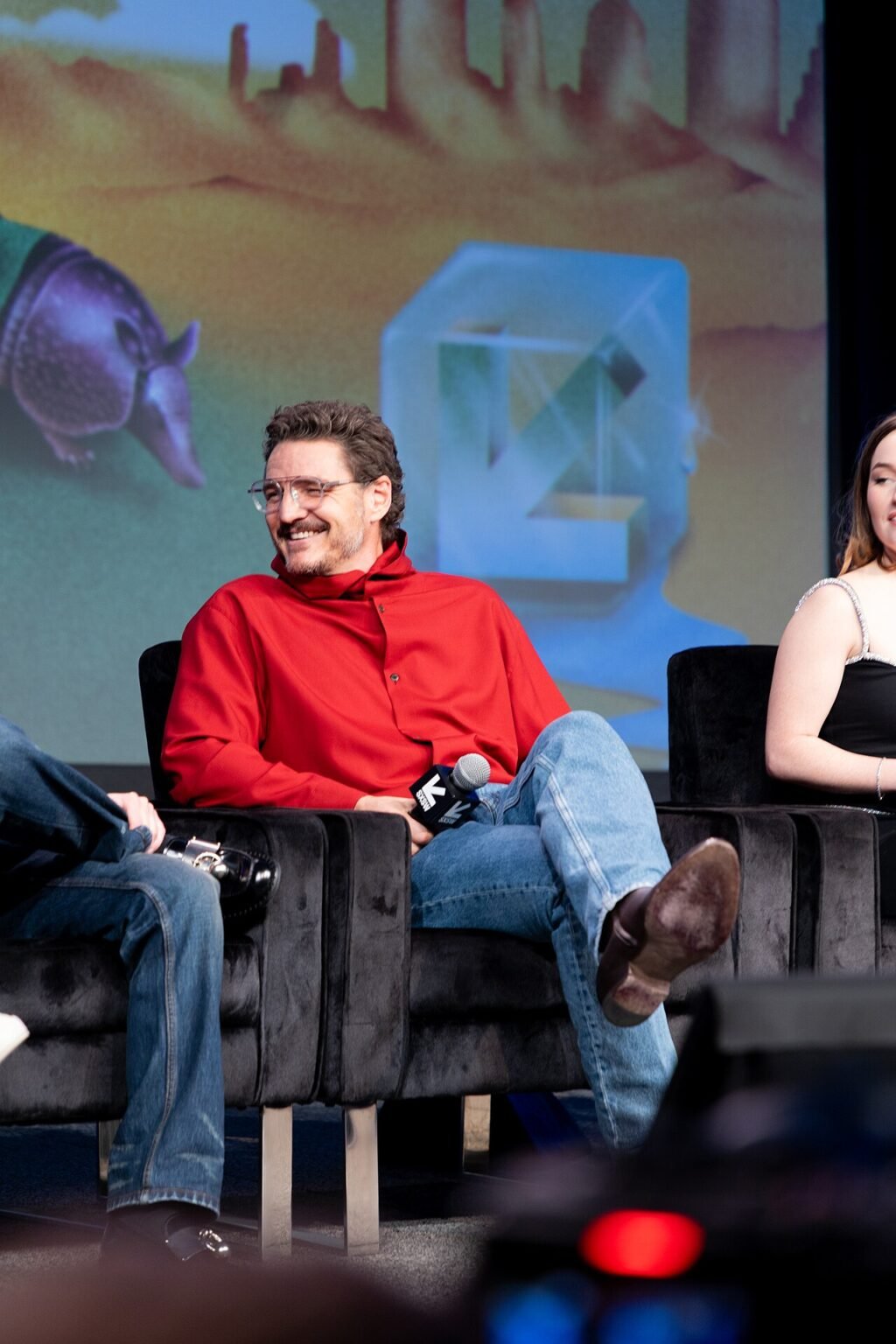
Photo: Phibeatrice via Wikimedia Commons (CC BY-SA 4.0)
There’s something genuinely thrilling about watching an actor everybody thinks they have figured out suddenly do the thing nobody saw coming. Pedro Pascal has spent the last few years as the internet’s favorite dad — the tender, growling, helmet-wearing guardian of The Mandalorian, the grieving protector of The Last of Us, and, as of this year, Marvel’s own Reed Richards in The Fantastic Four: First Steps. So on Friday night, the sight of Pascal strolling into the New York Film Festival for the world premiere of Behemoth! as a tortured classical cellist in a Tony Gilroy character study felt less like another red carpet appearance and more like a genuine reset button on a career that has been running red-hot.
Pascal walked the carpet at Alice Tully Hall on Friday, October 2, joined by co-stars Will Arnett, Margarita Levieva, and Matthew Lillard, for the Centerpiece screening of the 64th New York Film Festival. And if the early chatter coming out of the premiere is anything to go by, this is the kind of film people are going to be talking about for the rest of the year — the kind where a movie star takes off the armor and does the bravest thing an actor can do: play somebody complicated, flawed, and not remotely cool.
A Cellist, a Crisis, and Two Decades of Regret
So what is Behemoth! actually about? In the film, Pascal plays Alex Serian, a former child prodigy and celebrated cellist who has spent two decades on the road with some of the most prestigious orchestras in the country — stints in Dallas and Chicago among them — and has now washed back up in Los Angeles, where he takes work as a studio musician recording Hollywood film scores. For a musician of his caliber, that’s not a job. That’s a come-down.
The story, which spans roughly twenty years of Alex’s life, slowly peels back why he left his old life behind and what dragged him back to the city where all his unfinished business lives. His ex-girlfriend Carol, played by Olivia Wilde, is a manic, complicated force in his rearview mirror. His new love interest, Nadia, is played by Eva Victor, fresh off the breakout indie Sorry, Baby. There’s also Alex’s brother Andy, played by Will Arnett, a rock musician trying to keep the family musical legacy afloat, and his father Peter, played by Hank Azaria. Rounding out the ensemble: Alexa Swinton as Viviana, a teenage musical artist who becomes Alex’s unexpected obsession, plus Margarita Levieva, Matthew Lillard, JoBeth Williams, Erik Griffin, Kaya Ralls, and Barry Livingston.
Gilroy structures the whole thing like a piece of music itself. The narrative is nonlinear, with musical cues triggering flashbacks that jump across the last twenty years, and the film keeps cutting between the orchestra Alex is working with and his real life. The score isn’t just background here — it works as an active storytelling layer, almost as if Alex is sitting in on his own life the way a composer watches a film, conducting the moments that mattered most as they replay in front of him. It’s a bold device, and it’s exactly the kind of thing that makes people either adore a movie or argue about it in the lobby for an hour afterward.
Tony Gilroy’s Long-Awaited Return Behind the Camera
Let’s talk about Tony Gilroy for a second, because this premiere was as much his night as Pascal’s. Gilroy, the Academy Award-nominated writer-director of Michael Clayton, hasn’t directed a feature film since The Bourne Legacy back in 2012. That’s fourteen years. In the interim, he became the man who saved Star Wars television — the creator, showrunner, and chief architect of Andor, the Disney+ series that fans and critics almost universally regard as the finest live-action Star Wars ever made.
Gilroy’s name is all over some of the smartest screenwriting of the last three decades: the first three Bourne films, Michael Clayton, Duplicity, and Rogue One: A Star Wars Story. His work has always been obsessed with hyper-competent people discovering the limits of their competence — spies who can’t quite outsmart the system, lawyers who know the game is rigged. Turning that gaze toward a musician having a full-blown personal crisis is a change of scale that clearly excited him. He wrote and directed the whole thing himself, and he even brought in his brother John Gilroy to edit it, with Sanne Wohlenberg producing alongside them.
It makes total sense that the New York Film Festival picked Behemoth! as its Centerpiece selection. Gilroy has said the festival has been his benchmark since he was a young bartender across the street, once handed a single ticket to a screening that changed his life. Standing on that stage fourteen years after his last film, premiering something this personal, must have felt like coming full circle.
Pascal Says the Cello Was the Hardest Work of His Career
Pascal didn’t just show up and hold an instrument convincingly. He actually learned the cello for the role — and at the premiere’s press conference, moderated by New Yorker critic Justin Chang alongside Gilroy, Eva Victor, and Will Arnett, he described the experience as somewhere between hell and heaven, and flatly called it the hardest creative challenge he’s ever taken on as an actor.
Asked whether learning the cello had anything in common with his other work, Pascal laughed and said it overlapped with simply remembering he had lines to learn, or that there was an actual character to play beyond the instrument. The cello, he said, became “the main character of my life” for several weeks before shooting — he carried it everywhere on Gilroy’s advice, living with the thing the way a musician actually would.
That’s a bigger deal than it sounds. Pascal has done serious dramatic work before — his Oscar-nominated turn in Dreamgirls showed he could do more than make people laugh, and his recent years have been stuffed with prestige projects. But playing a classical musician convincingly is its own brutal craft. You can’t fake a bow hold in close-up. You can’t fake the posture, the breathing, the listening. Audiences who play music spot fakes instantly, and there’s no cutaway generous enough to save you. The fact that he threw himself into it this completely tells you how much he wanted this role to land.
Nine Composers, One Score
Here’s the detail that genuinely stopped me in my tracks: Behemoth! doesn’t have one composer. It has nine. Michael Abels, Emily Bear, Lukas Frank, Michael Giacchino, James Newton Howard, Henry Jackman, Nami Melumad, Brandon Roberts, and Alan Silvestri all contributed to the film’s music, each writing for a different fictional film-within-the-film that Alex scores for his studio work.
Think about that for a moment. You’re looking at the combined talent behind Get Out, The Incredibles, The Hunger Games, Captain America: The Winter Soldier, Back to the Future, Forrest Gump, and Andor — all writing music for movies that don’t exist, inside a movie about a man composing the soundtrack of his own life. It’s gloriously meta, and exactly the kind of ambitious swing that gets film nerds genuinely excited.
There’s a delicious wrinkle, too: Academy rules cap a film score at three credited composers, which means Behemoth!‘s score is likely ineligible for an Oscar — a film about a composer whose own music can’t be nominated. You can’t make this stuff up. Or rather, Tony Gilroy just did.
What the Critics Are Saying
The first reviews out of the festival have been mostly positive with some mixed reactions sprinkled in — which, honestly, is exactly what you’d expect from an ambitious, formally adventurous character study. IndieWire handed it a B+, TheWrap and The Daily Beast came out positive, Slant gave it 3 out of 4, and Next Best Picture scored it 7 out of 10. The Guardian was less impressed at 2 out of 5, and Variety, Screen, and The Hollywood Reporter landed somewhere in the mixed-to-negative zone.
But here’s what caught my eye: the praise for Pascal has been near-universal. Multiple reviewers have called it the finest and most complex performance of his career, which is quite a statement about an actor who just spent two years headlining two of television’s biggest shows and fronting a Marvel movie. One thing the divisive reviews actually agree on is that Pascal is doing something special here — the disagreements are about the film’s structure and ambition, not its star.
That kind of split is often a good sign for a film’s long-term life, by the way. The movies we still argue about are rarely the ones everyone agreed were “fine.” And for a December release from Searchlight Pictures — the studio behind so many recent awards darlings — a little controversy at the premiere is basically free marketing.
Pascal’s Unbelievable Run Continues
Zoom out for a second and appreciate what a year Pascal has had. He returned as Din Djarin in Star Wars: The Mandalorian and Grogu, which hit cinemas in May with Jon Favreau directing and Sigourney Weaver and Jeremy Allen White joining the ride. He played Reed Richards, a.k.a. Mister Fantastic, in Marvel Studios’ The Fantastic Four: First Steps. He’s still carrying The Last of Us as Joel Miller, still beloved for Oberyn Martell on Game of Thrones and Javier Peña on Narcos. And in between all of that, he quietly went off and learned the cello for a Tony Gilroy character study.
That’s the thing about Pascal that makes this premiere feel like a moment. He could have spent the rest of his career cashing franchise checks — the industry would have happily let him. Instead, he’s using the biggest leverage of his career to work with the Andor guy on an original drama about a broken musician, playing scenes opposite Olivia Wilde and Eva Victor, in a movie that premiered as the Centerpiece of NYFF and arrives in US theaters on December 4 through Searchlight Pictures, right in the heart of awards season.
Friday night at Alice Tully Hall, surrounded by his cast, Pascal looked like a man who knew exactly what he was doing. The helmet is off. The cello is out. And if the first wave of reviews is any indication, we may be watching one of the best actors of his generation do the best work of his life.
Source: Just Jared