
Denver Residents Face $1,000 Fines as Drought Tightens Outdoor Watering Rules
Denver residents are facing tighter outdoor watering rules as drought conditions deepen across Colorado, with repeat violations potentially leading to fines of up to $1,000. The restrictions apply to customers served by Denver Water, which supplies about 1.5 million people in Denver and surrounding suburbs. The utility declared a Stage 1 drought in March 2026 after historically weak mountain snowpack and below-average reservoir levels raised concerns about the region’s water supply.
The Denver Water restrictions require customers to limit outdoor watering to two assigned days each week. Even-numbered single-family homes may water on Sundays and Thursdays, while odd-numbered homes are assigned Wednesdays and Saturdays. Multifamily properties and most commercial customers are generally limited to Tuesdays and Fridays. Lawn watering is also restricted to cooler hours, before 10 a.m. or after 6 p.m., to reduce evaporation.
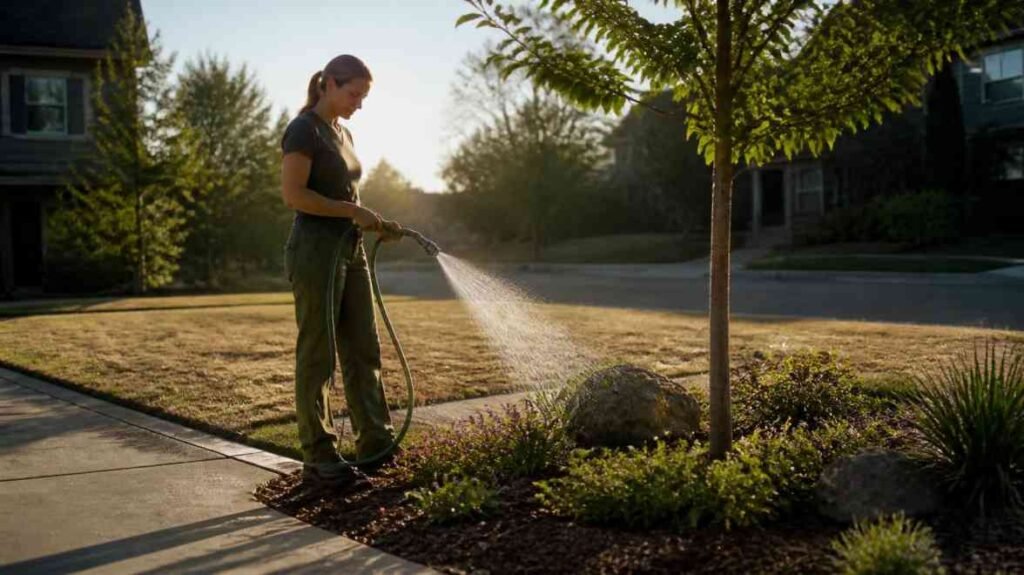
Residents must also avoid watering during rain or high winds, keep water off streets and sidewalks, and repair broken or leaking sprinkler systems within 10 days. Hand-watering of trees, shrubs, flowers and vegetables is still permitted on any day, although it is not allowed between 10 a.m. and 6 p.m. Denver Water also requires a hose nozzle with a shut-off valve when customers hand-water or wash a vehicle.
Why Denver Is Tightening Water Rules
The restrictions are not simply a seasonal reminder. Denver Water says the 2025-26 snowpack peaked unusually early and at exceptionally low levels in the basins that feed its system. In the Colorado River Basin, snowpack peaked at 58% of normal, while the South Platte River Basin peaked at only 42% of normal. Both peaks came more than a month earlier than their typical dates.
Reservoir storage has also fallen well below usual levels. Denver Water reported that its overall reservoirs were at about 75% of capacity at the end of July, compared with roughly 96% in a typical year. The utility expects storage to continue declining as customers use water through the remainder of the warm season.
That backdrop explains why the Denver Water restrictions are being enforced more aggressively. The utility has asked customers to reduce total water use by at least 20% in an effort to preserve supplies and reduce the risk of even stricter measures later.
Repeat Violations Can Cost Up to $1,000
The enforcement system starts with education rather than an immediate financial penalty. A first violation brings a warning. A second violation for a single-family residential customer can result in a $250 charge, the third can cost $500, and a fourth can bring a $1,000 charge.
CBS Colorado reported on August 13 that roughly 150 warnings and 15 fines had already been issued. Denver Water had also received more than 6,000 community reports about possible violations. The utility can use customer water-use data alongside reports from the public to identify households that may not be following the rules.
This is an important clarification to some viral coverage of the story. The rules affect a system serving about 1.5 million people, but that does not mean more than a million customers have personally received violation warnings. The confirmed enforcement numbers reported by CBS were far smaller.
Could the Rules Become Even Stricter?
The Denver Water restrictions may tighten further if dry conditions continue. Denver Water said on August 17 that it was considering ending lawn watering season on October 1. If approved by the Board of Water Commissioners, customers would have to turn off spray irrigation systems after September 30, while still being allowed to hand-water trees and plants.
Colorado’s wider drought picture adds urgency. The U.S. Drought Monitor showed large portions of Colorado experiencing severe, extreme or exceptional drought in August, with drought conditions having intensified in and around the Denver area during the summer.
The current rules are therefore designed to protect stored water before the region enters winter, when future supply will depend heavily on the next mountain snow season.
What Residents Should Do Now
For people in the Denver Water service area, the simplest step is to check their assigned watering days and keep sprinkler use within the permitted morning and evening hours. Skipping a scheduled watering day after rain can reduce demand further, while drip irrigation or hand-watering can help protect important plants without running large spray systems.
The Denver Water restrictions also show how drought management can move quickly from voluntary conservation to mandatory rules when reservoirs and snowpack fall behind. With officials already discussing stronger measures for October, customers who continue watering as if conditions were normal could face both higher charges and tighter limits.
For now, the message from the utility is straightforward: use less water, follow the two-day schedule and avoid unnecessary outdoor use. Whether those efforts are enough to prevent additional restrictions will depend on customer conservation, late-summer weather and, ultimately, how much snow Colorado receives during the next winter season.